
Perth Amboy Previous Residents by Era
Previous residents of a Perth Amboy address leave different kinds of records in different periods. Begin with the parcel identity, then choose the source that fits the era. A current owner display, a recorded deed, a directory line, and a tax list answer different questions. The table separates ownership evidence from household evidence and shows where the paper or online trail changes. Date every result. A later record should never be used to fill an earlier gap without support.
| Source | Years It Covers | Where Held | What It Shows |
|---|---|---|---|
| Middlesex official deed index | Deeds 1929-present; mortgages 1950-present; other documents 1958-present | Middlesex County Clerk Public Search | Recorded parties, document details, town, dates, book/page, and instrument locators. |
| Middlesex deed indexes and grantees | 1692-1926 | New Jersey State Archives guide and historical access channels | Earlier deed-chain leads when the online index ends. |
| Perth Amboy Township tax ratables | 1780, 1784-86, 1789, 1793, 1797, 1808-10, 1817-20, 1822 | New Jersey State Archives | Taxable person, property, and locality in selected years. |
| Directory and newspaper runs | Richmond 1912-15; Polk 1931; NARA 1929-31 and 1935; Evening News 1903-1959 | Library, National Archives listings, and Library of Congress | Historical address and household clues, notices, and alternate spellings. |
| Census materials | Federal special schedules 1820-1890; New Jersey state censuses 1855-1915 | Archival and library research channels | Household evidence subject to each schedule's survival and availability. |
Use the county's online record index for the newer recorded-land trail. For earlier years, shift to the County Clerk's records, the Archives guides, Rutgers, the historical society, and library collections. Those channels are part of the search, not a last resort.
Note: A deed records a transfer, while a directory or census may describe a household during its own dated period.
Current Parcels for Perth Amboy Previous Residents
Start the backward trail with the exact parcel, not merely a street name. The Perth Amboy Tax Assessor maintains ownership, mailing address, location, year built, land size, structure characteristics, and assessment data for more than 9,500 properties. The city page does not expose a confirmed public name-search form, so do not assume a name can be entered into a live assessor search. Use the assessor's maintained parcel context, tax map, or staff route, then preserve the block, lot, parcel identifier, situs address, and legal description. That shared parcel identity keeps a previous-residents search tied to the right property.
NJGIN Property Explorer can search by address, county, municipality, block, and lot. Middlesex GIS adds parcel geometry and an OwnersName display field. Both are snapshots. State-hosted parcel data can redact owner names under Daniel's Law, and a GIS owner display does not prove that someone occupied the address. The stable bridge between a tax record and an older deed is usually the legal description and block-lot combination.
Perth Amboy Deed Search Cutoffs
The Middlesex County Official Records Public Search is the online start for a Perth Amboy property chain. Its stated coverage begins on January 1, 1929 for deeds, January 1, 1950 for mortgages, and January 1, 1958 for other document types. The County land-record information says older books and copies remain at the office. That division controls the research plan: do not keep retrying a web query after the chain reaches its documented cutoff. A previous-residents trail simply moves to the earlier holding channel.
The portal permits party-name, document-type, town, date-range, consideration, instrument, book/page, lot/block, legal-description, map, parcel, and parcel-ID searching. Party names use a last-name first format with no comma. Search results carry status information, including verified indicators, replaced records, and corrections. Save the town, instrument number or book/page, date, and status with each step. The available search view does not settle all image, payment, or copy behavior, so confirm those terms at the time of use.
Trace a Perth Amboy Deed Chain Backward
A chain of title is the sequence of recorded transfers tied to the same property. It should move through the legal parcel identity, not through a guess based on similar surnames. The current grantee can be the prior grantor on the next older deed, but estates, corporations, sheriffs, municipalities, and subdivision instruments can interrupt a simple person-to-person pattern. Use the instrument and legal description to test every connection.
- Record the current situs address, municipality, block, lot, map number, parcel ID, and legal description from the parcel sources.
- Use lot/block, parcel ID, legal description, and party name in the county index. Compare the town, date, status, and instrument locator.
- Identify the deed that brought the current grantee into the chain, then search that prior owner as needed to find the next older transfer.
- Use consideration, dates, and parcel geometry to separate people with similar names and to check for a subdivision or changed description.
- When the trail reaches before 1929, move to the County Clerk record room and the New Jersey Archives Middlesex grantor-grantee material.
- Pair every transfer with a dated directory, census, tax ratable, newspaper notice, permit, or obituary before describing who lived there.
- Grantor
- The party transferring an interest in a recorded instrument.
- Grantee
- The party receiving that interest in the instrument.
- Chain of title
- The documented sequence of transfers connected to one parcel or legal description.
- Legal description
- The land description in a deed or map, used to identify a parcel when a street number changes.
Perth Amboy Owners and Past Residents
Ownership and occupancy are different evidence. A deed identifies recorded parties to a transfer. An assessor record can show a maintained owner field and a mailing address. A directory may show an address and name for the year it was published. A census may place people in a household at the time of enumeration. None alone proves all of the others. Keep each result in its own column, with the source date and the role it actually supports.
This distinction is especially important where a mailing address differs from the situs address. A mailing address can belong to a separate property, agent, organization, or out-of-area contact. A directory address can be a business or another publishing convention. Past residents should therefore be identified only through a source that actually places the household at that address during the relevant period.
Perth Amboy Township in Older Records
Older Perth Amboy sources may not use the city label. Perth Amboy Township formed in 1693, and the city was re-incorporated in 1844 after absorbing the township. A historical deed, tax ratable, road record, or directory result may therefore be filed under township, city, county, or a neighboring place. Preserve that wording in the citation. It can explain a no-result that a modern address search cannot solve, especially when checking who lived here before.
There is no verified citywide house-number renumbering date in the research. Do not invent one when an old number looks unfamiliar. Resolve it through a dated deed legal description, Sanborn sheet, tax map, newspaper notice, or library source. There is likewise no verified account of a single courthouse fire erasing a Perth Amboy decade. Record an unproven gap as a gap.
Perth Amboy Tax Ratable Years
Tax ratables can extend a property story before printed directories. The State Archives guide lists Perth Amboy Township material for 1780, 1784-86, 1789, 1793, 1797, 1808-10, 1817-20, and 1822. These are selected historical tax lists, not an annual roster. They can connect a taxable person or property to a locality, but a name there does not establish a street address or a full household.
Perth Amboy Local History describes an in-building collection of history, genealogy, biographies, personal papers, local organizations, and original library documents. Fragile material stays in the building.
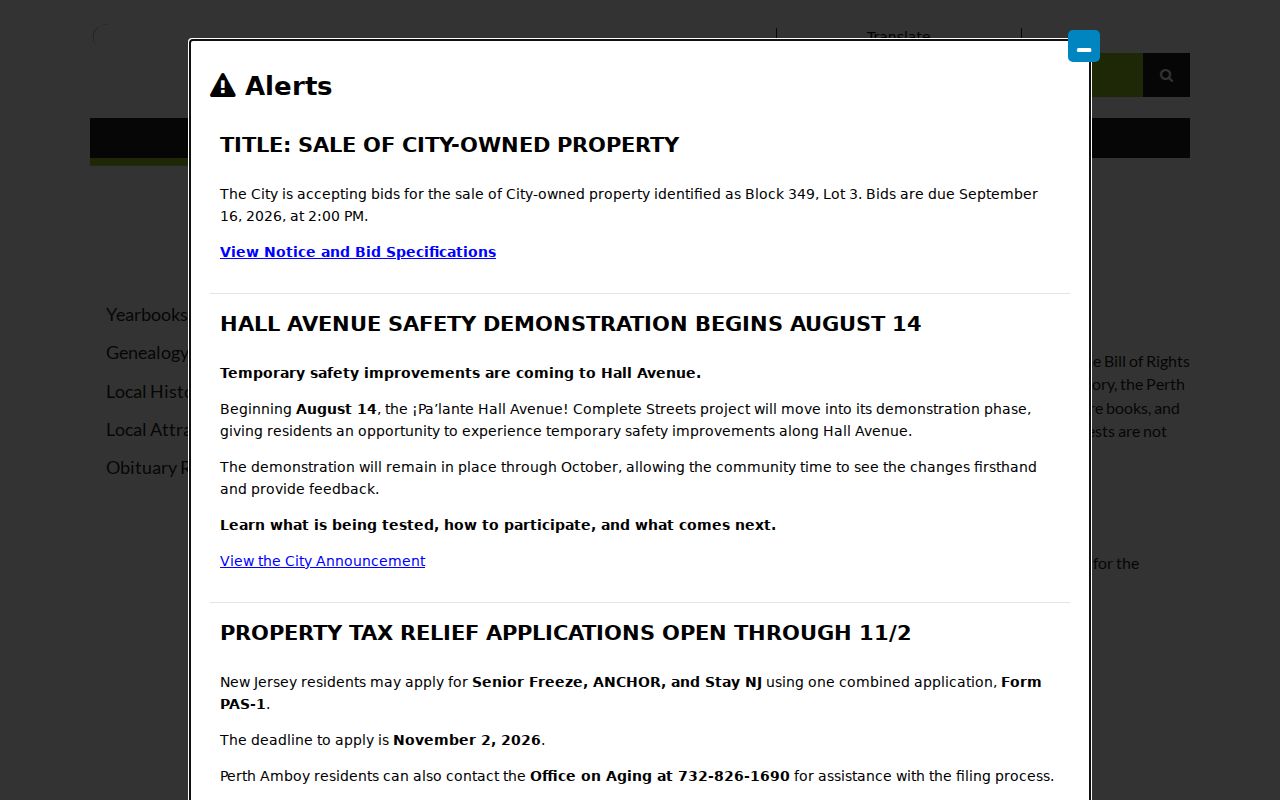
The Local History screen is a practical access lead for a tax-list, directory, map, or newspaper question that cannot be resolved from a public web index.
Perth Amboy Past Residents in Directories
To identify who lived at an address after the property trail is in hand, use the dated local directory runs and census materials as a household layer. Richmond's 1912-15 directories, the 1931 Polk volume, and NARA holdings for 1929-31 and 1935 are known access points. The Perth Amboy Free Public Library also reports city directories, City Files, high-school yearbooks, and local newspaper microfilm. Exact reverse or criss-cross holdings have not been published, so ask Local History for titles and years rather than claiming a complete address-directory run.
- Choose the directory or census nearest to the ownership transfer or address event.
- Copy the name, street form, source date, page, and any visible notation without expanding an abbreviation by guesswork.
- Check the closest preceding and following directory years, marking appearances as dated observations.
- Compare the household clue with a census schedule, obituary, deed, tax ratable, or newspaper item.
- Keep a business, organization, and household entry distinct unless an independent source connects them.
The collections, their restrictions, and the correct way to transcribe a visible line are covered on the Perth Amboy Directory Book. A directory is publication-date evidence, not a current-address claim.
Note: Use census and directory entries together, because each source has separate dates, coverage limits, and naming conventions.
Perth Amboy Address Tests With Maps
When an old street number does not fit the current parcel picture, test the address against visual and contemporary sources. The Library of Congress holds a November 1891 Perth Amboy Sanborn set with 12 sheets. It can show building footprints, neighboring structures, and historical street context. It is spatial evidence, not a person index. Compare the sheet with the present parcel geometry before treating an old address as the same site.
The Evening News ran from 1903 through 1959 and survives through Library of Congress digital issues and library microfilm. Search an address with a surname, first initial, spouse or organization term. OCR can misread old type, diacritics, street abbreviations, and numerals, so open the image before recording a result. Newspaper notices can date an address event, but they should be paired with the deed or directory trail.
Perth Amboy Previous Residents Archive Route
When the online deed chain stops, the New Jersey State Archives guide points to Middlesex deed indexes and grantee material from 1692 through 1926. The Archives has a public research room in Trenton, with appointment or walk-in access when space permits. Middlesex County Historical Society has family papers, church records, diaries, cemetery inscriptions, city directories, maps, and photographs by appointment. Its access terms are members free, nonmembers $10 per day, and $0.25 per photocopy. These routes can extend a past-residents search without turning a dated record into present occupancy.
Rutgers' Middlesex County records finding aid describes an incomplete county court book from 1688-1711, deeds and conveyances from 1714-1722, public roads, marriage indexes, election returns, and other series with their own survival limits.
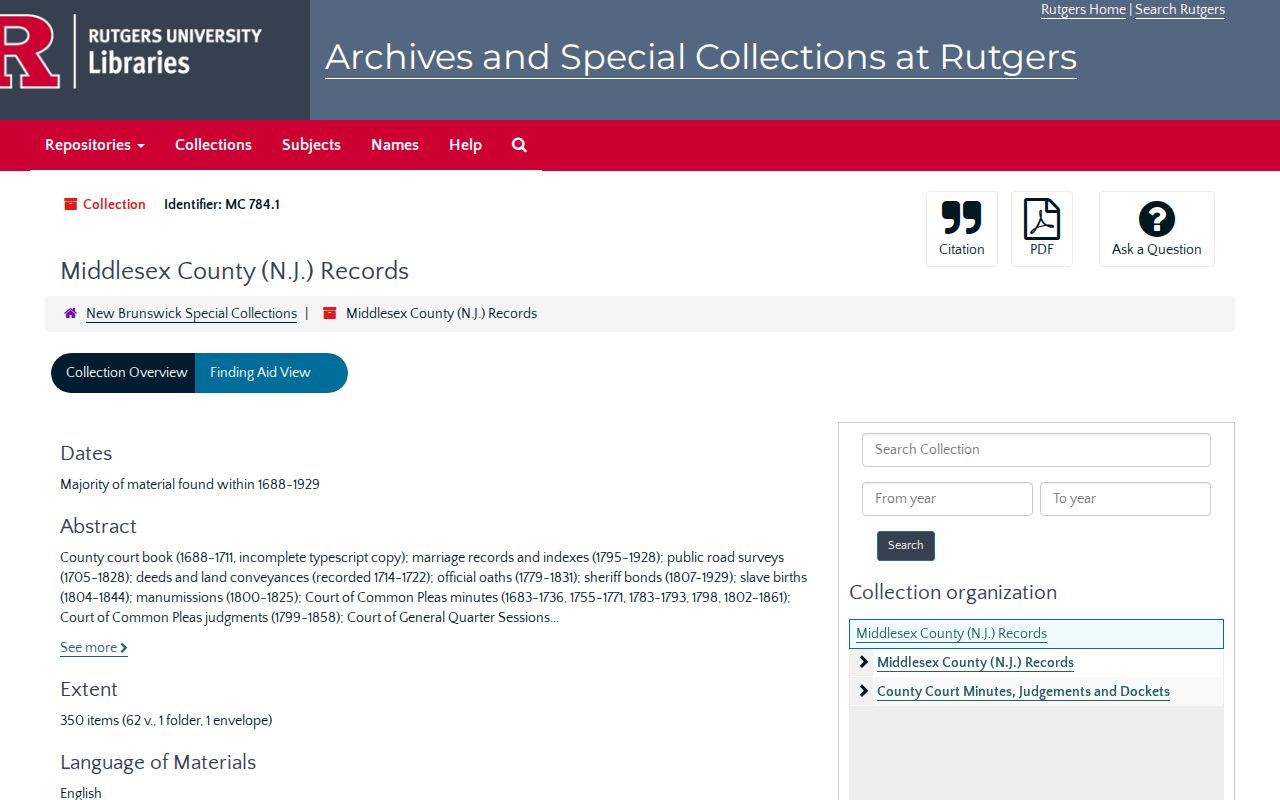
The Rutgers collection image is a finding-aid lead. It identifies series to ask for, rather than presenting a continuous online index of past residents.
Perth Amboy Address Change Over Time
Perth Amboy's waterfront history can account for a changing record trail. Ferry service ran from 1709 to 1963, and industrial or waterfront activity can place the same street in deeds, directories, advertisements, and historical files under different uses. A record could identify a home, business, organization, public office, or an unknown use. Label it by the source instead of assuming that every named street entry is a household.
The city library's November 2025 historic-site designation may also lead to later preservation inventories, photographs, and building-history material. It is not a list of past residents. Date and cite any new inventory before adding it to an address history.